View this edition in our enhanced digital edition format with supporting visual insight and information.
Most family enterprise boards perform exactly the job they were designed to do. In this week’s FFI Practitioner, Stephan Roche argues for redesigning the board’s job to support thriving multigenerational family enterprises and offers five principles that separate a family enterprise board built for performance from one built for continuity.
When a family enterprise fails to endure, it is tempting to look first at the business. Was the strategy wrong? Did the market shift? Did performance falter? All too often the decisive problem sits elsewhere: the governance that served one generation was never designed to carry the family and the business through the next.
Most family enterprise boards do exactly what they were designed to do. The question is whether they were designed for the right job. A performance board asks an essential question: are we meeting our financial obligations? A stewardship board asks a larger one: are we building a thriving multigenerational family enterprise?
The point is not that performance matters less. Sound oversight, disciplined decision-making, and financial results remain essential. But in a family enterprise, they are not enough. The board must also understand why this family owns together, what it seeks to accomplish through that ownership, and what it will take to sustain both the enterprise and the family’s commitment to it over generations. These are questions that boards of public companies or private-equity-owned businesses rarely confront.
This shift requires a different understanding of the family enterprise board’s role. It is not only an oversight body charged with monitoring performance; it is also a steward of continuity, responsible for helping the family and the enterprise remain aligned across generations. Five principles distinguish a true stewardship board.
Principle One: Purpose Before Performance
Let’s begin with a deceptively simple question. Does the board know the family’s owner strategy, and is it written down?
At the heart of an owner strategy is the family’s purpose for owning together. Families want different things from ownership, which may include financial return, liquidity, family employment, legacy, identity, impact, or some combination of them. None of these is inherently right or wrong. What matters is that owners make their priorities explicit enough for a board to act on.
Without that clarity, a board defaults toward whatever is easiest to measure. Revenue, growth, and profitability deserve close attention. But quarterly results cannot tell a family whether the enterprise is still fulfilling the reason they own it together. A business can perform well financially while its owners grow steadily more divided about its direction. It can also make a choice that looks suboptimal in a single quarter but strengthens the enterprise over decades.
If a board does not know and fully understand the owner strategy, what is it holding itself accountable for? In practice, the answer defaults to financial metrics, and then to whichever measure happens to be nearest at hand.
A stewardship board does both things at once. It holds management accountable for performance and tests consequential decisions against the owners’ stated purpose. Purpose becomes a lens for making decisions rather than a statement framed on a wall. It helps the board weigh trade-offs, set expectations, and distinguish the opportunities that fit the family’s ambitions from those that would pull the enterprise away from them.
Principle Two: Treat Succession as Permanent Work
One of the costliest mistakes families make is treating succession as a singular event, a hard transition to plan, execute, and then put behind them.
The truth is there is no post-succession resting phase. The next transition begins the day the current one ends.
This reframing turns succession from a crisis to be survived into a discipline to be practiced. The board should be asking continually what leadership the enterprise will need next, how candidates will be assessed, which experiences they should be gaining now, and how an incumbent can eventually step away with dignity. When those conversations begin only after a departure is imminent, the family’s choices have already narrowed.
This work does not stop at the CEO’s chair. The loss of a head of sales, a CFO, or a long-serving operator can expose vulnerabilities that were easy to overlook while that person was in place. A stewardship board asks whether the bench is deep enough, whether knowledge is being transferred, and whether promising leaders are getting the assignments and the candid feedback they need to grow.
For family candidates, this discipline matters most. Continuous succession work creates clear expectations and development paths, so that a family name becomes neither an automatic qualification nor an automatic disqualification. The goal is not to guarantee anyone a role. It is to give capable people a fair chance to prepare for one, and to give the board a credible basis for choosing among them.
Succession is a practice, not an event. A board that practices succession rather than staging it periodically creates more options, lowers the emotional temperature around any single transition, and makes continuity part of its ordinary work.
Principle Three: Treat Independence as a Gift, Not a Threat
Independent directors can be difficult for families to embrace. Inviting an outsider into the boardroom may feel like surrendering control or exposing private family matters to someone who cannot fully understand them. But the right independent director does not diminish the family’s voice. That person helps the family hear its own voice more clearly.
Family directors bring context, commitment, and a lived understanding of the enterprise’s history. Independent directors bring something different: expert perspective unburdened by that history. They can ask questions family members stopped asking, challenge assumptions that have hardened into facts, and notice patterns that may be difficult to see from inside the system.
I have served as an independent director on several family enterprise boards, and much of my value arises from what I don’t carry into the room. I don’t have decades of family history attached to a particular decision. I’m not protecting an old alliance or reacting to an old disappointment. I can listen to the substance of the discussion and ask what the enterprise and its owners need now.
That does not make an independent director wiser than a family director, and independence is no substitute for family engagement. The strongest boards combine the family’s knowledge and long-term commitment with outside judgment and experience. The two perspectives sharpen each other.
The best compliment an independent director can receive is, “We never thought of it that way.” That is precisely what independence is for. Not to disrupt a decision or take it away from the family, but to widen the range and raise the quality of the thinking behind it.
Principle Four: Make Governance Serve the Family
Governance is often treated as a synonym for bureaucracy. At its core, it answers three questions: who has the authority to decide what, who should be consulted, and who is accountable for the outcome.
Clear answers create speed. Well-articulated governance makes decisions faster, not slower, because everyone knows who holds the decision. It also reduces the risk a disagreement about a decision becomes a conflict about who had the right to make it.
But structures are tools, not sacred texts. Bylaws and decision rights written twenty years ago reflected the family, the ownership group, and the business of that moment. As the enterprise grows, the ownership base widens, and new generations enter the system, yesterday’s solution may no longer serve today’s needs.
The answer is not to abandon structure whenever it becomes inconvenient. It is to review governance deliberately. Are decision rights clear? Are the right voices represented? Are owners receiving the information they need? Does the board have the capabilities this strategy requires? Do family members understand how they can participate, and how decisions affecting them will be made?
Families get into trouble defending inherited arrangements long after the circumstances that produced them have changed. Continuity does not mean rigidity. Refreshing your governance won’t resolve a conflict that already exists, but well-designed governance prevents a great deal of the conflict that would otherwise arrive.
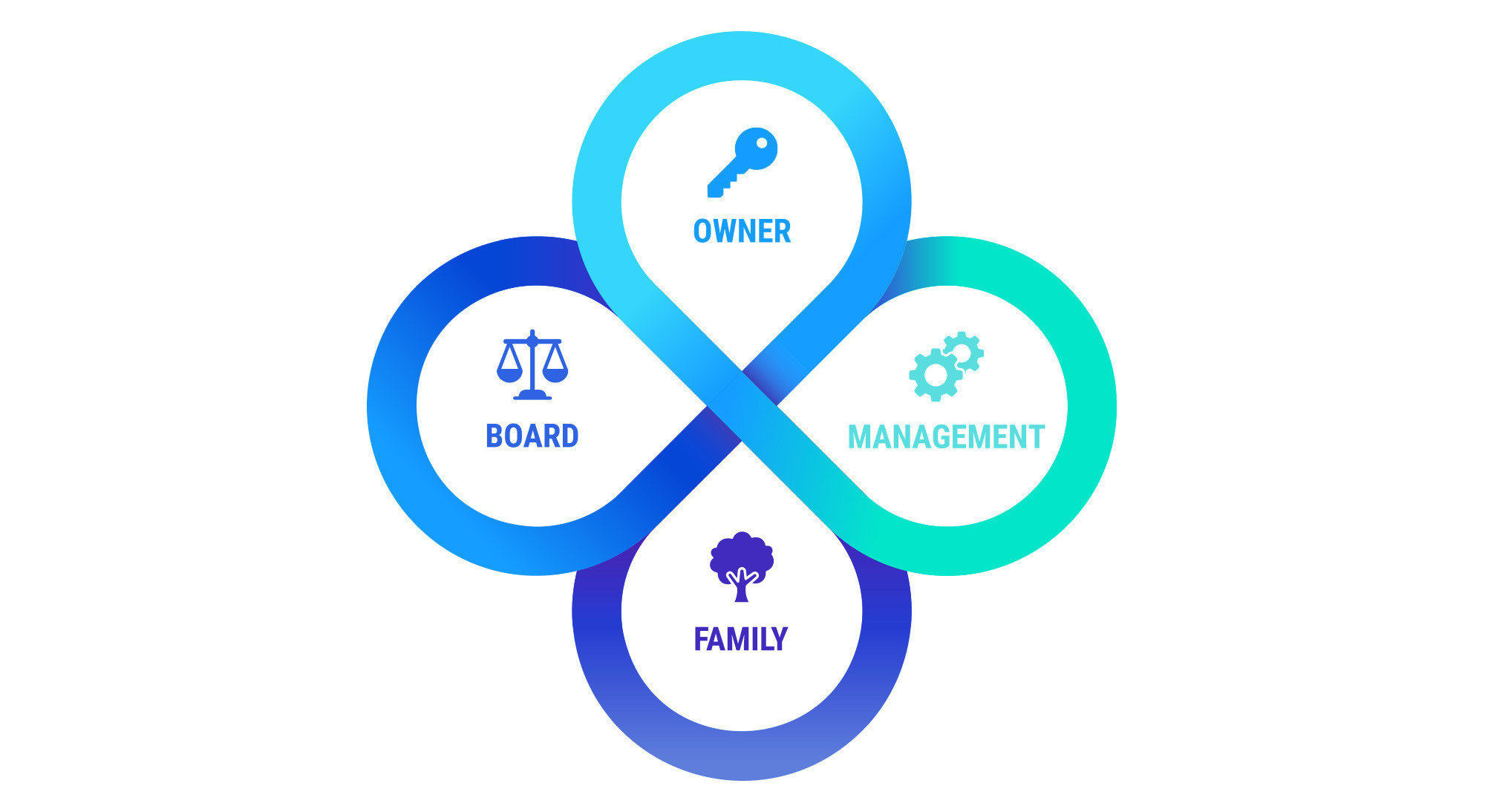
Principle Five: Connect the Rooms—Owner, Board, Management, and Family
At BanyanGlobal, we describe a family enterprise as having four rooms: the owners’ room, the boardroom, the family room, and management. Each has its own work. Owners establish what they want from shared ownership. The board provides oversight and direction. Management runs the business. The family room builds the understanding, relationships, and capabilities family members need to navigate their connection to the enterprise.
Trouble arrives when the rooms disconnect, or when a conversation happens in the wrong one. A family concern gets pushed into a management meeting. A board tries to define the owners’ purpose rather than receiving it from them. Owners intervene in operating decisions because no other forum exists in which to make their priorities heard.
A stewardship board connects the rooms without collapsing the walls between them. It takes direction from a clearly articulated owner strategy, translates that direction into expectations for the business, and holds management accountable for delivering against them. It also pays attention to the health and readiness of the wider family, because change there eventually reaches ownership, leadership, and strategy.
A board that ignores family dynamics is flying blind. A board captured by family dynamics cannot serve the business. Holding that tension takes effort, and it is why the board is more than a meeting that happens several times a year. It is the hinge of the governance system.
This matters more as the family grows. In the founder generation, one or two people may hold ownership, family leadership, board authority, and executive responsibility at the same time. In later generations, those roles separate. Good governance makes that separation understandable and workable.
Designing for the Next Generation
A performance board can tell a family whether the enterprise is meeting its obligations today. A stewardship board also asks whether the family and the enterprise are becoming more capable of navigating tomorrow.
That longer horizon changes the agenda. Purpose becomes a criterion for decisions. Succession becomes continuous. Independence becomes a source of perspective rather than a threat to control. Governance evolves as the family and enterprise change. And the board connects owners, family, and management while protecting the distinct role of each.
The families who endure build governance that outlives the founder, holds the family’s purpose when individual members disagree, and makes room for the next generation before it is urgent. A shared purpose is what allows a family to disagree productively.
So put one question to the family’s board, reaching past the next meeting and the next quarter. If this board were designed to serve the family thirty years from now rather than only today, what would be different about it?
That may be the most valuable question you can ask.
About the Contributor

Stephan Roche is managing partner of BanyanGlobal Family Business Advisors and serves as an independent director on family enterprise boards.
View this edition in our enhanced digital edition format with supporting visual insight and information.