


View this edition in our enhanced digital edition format with supporting visual insight and information.
What happens when three legal systems lay claim to one family’s legacy? In this week’s edition of FFI Practitioner, Dennis Owusu Oteng and Mercy Edukugho-Aminah examine how statutory, customary, and religious law intersect in West African family enterprises—and why effective succession planning requires advisors to understand both legal entitlements and the social forces that shape implementation.
Picture a family meeting convened to settle the estate of a patriarch in Lagos. Seated around the table are the deceased’s widow, his children from two marriages, his eldest brother, an imam, and a lawyer. Each of them arrives carrying a different understanding of who is entitled to what—and each of them is right, according to the legal system they are drawing from. The widow looks to the statutory framework. The eldest brother invokes customary succession. The imam references the faraid rules of Islamic inheritance. The children’s lawyer cites the constitution. No single person in that room is wrong. But no single plan can satisfy all of them unless the advisor understands the full legal landscape in which the family exists.
This is not an unusual scenario. Across much of West Africa, and in many family enterprise contexts globally, inheritance and wealth planning do not operate within a single, coherent legal framework. They operate within what legal scholars call legal pluralism—the coexistence of multiple systems of law within a single society, each asserting legitimate authority over the same people, the same families, and the same assets.
For the family enterprise advisor and the estate planner, legal pluralism is not an academic concept. It is a daily reality that shapes what plans can be built, how they will be implemented, and whether they will survive the moment of succession.
The Three Systems and Their Claims
In West Africa, as in many regions with layered colonial and indigenous histories, three systems of law operate simultaneously over the same families. The first is statutory law: the legislation enacted by the state, including constitutional provisions, family law statutes, and property legislation. The second is customary law: the inherited norms of the client’s ethnic or local community, which govern succession, land tenure, and family obligation through practice and collective memory rather than written enactment. The third is religious law: in Muslim-majority communities, this means the faraid system of Islamic inheritance, which prescribes fixed fractional shares for defined categories of heirs and significantly constrains testamentary freedom.
These three systems do not operate in tidy sequence, nor does one automatically supersede the others. They operate concurrently. A client may be simultaneously bound by a statutory intestacy regime, by the customary expectations of a patrilineal community, and by the religious obligation to distribute according to prescribed shares. In practice, the applicable rules may depend on a combination of factors: the client’s ethnicity, religious affiliation, the nature and location of the assets, the type of marriage contracted, and the forum in which any dispute is eventually pursued.
What the Jurisdictions Reveal
Three West African jurisdictions illustrate how these systems interact in practice—and what the consequences are for families and their advisors.
Nigeria
Nigeria presents perhaps the most complex illustration of legal pluralism in the region. The statutory framework coexists with a diverse array of customary systems tied to the country’s major ethnic groups, and with formally recognized Islamic law in twelve northern states. For many Nigerian families, the applicable inheritance rules depend entirely on which forum is engaged and which legal identity the claimant asserts.
Among the Igbo of southeastern Nigeria, customary law historically followed a strict primogeniture model that excluded women from inheritance entirely. This position was directly challenged by the Supreme Court in Ukeje v. Ukeje (2014) 11 NWLR (Pt. 1418) 384, in which the court held that the Igbo customary rule disinheriting female children was repugnant to natural justice, equity, and good conscience, and was inconsistent with section 42(1) of the 1999 Constitution of the Federal Republic of Nigeria. The decision was significant, but its practical reach has been uneven. Social expectations and community norms continue to shape outcomes on the ground, particularly in rural settings where formal legal authority is less immediately present.
In the north, the faraid system governs Muslim estates through Sharia courts. A testator operating under Islamic law may dispose of only up to one-third of the estate by will and may not make bequests to existing heirs without their consent. This creates a planning environment that is structurally different from what practitioners trained in civil or common law traditions are accustomed to—and requires a corresponding adjustment in advisory approach.
The plurality of forums also creates a structural vulnerability that the advisor must anticipate: forum shopping. Parties dissatisfied with the outcome of one legal system may seek recourse in another. A widow disadvantaged under customary rules may pursue her claim in a statutory court. An heir seeking a larger share may invoke Islamic principles to challenge a will executed under statutory law. The plan that does not anticipate this risk is a plan that has not been fully stress-tested.
Ghana
Ghana’s experience illustrates a different configuration. The Intestate Succession Law (PNDCL 111) represented a deliberate legislative effort to create minimum protections for surviving spouses and children across customary systems—a statutory floor beneath the diversity of customary practice. Among the Akan, inheritance traditionally follows a matrilineal system in which property devolves to the extended maternal family, the “abusua,” rather than to the deceased’s nuclear family. The statutory framework modifies this by allocating defined shares to spouses and children, thereby providing a degree of protection that customary rules alone do not guarantee.
Yet the enactment of a statutory framework does not dissolve the power of customary expectations. In practice, many Ghanaian beneficiaries—particularly in rural areas—remain unaware of their statutory rights, and social pressure may lead them to accept distributions that depart significantly from their legal entitlements. The advisor who relies solely on the formal instrument without accounting for the social dynamics of implementation risks producing a plan that is technically sound but practically fragile.
Senegal
Senegal’s Family Code offers a formally structured dual-track system: individuals may choose, at the time of marriage, between a civil regime governed by principles of gender equality and forced heirship, and an Islamic regime governed by the faraid rules. The architecture appears to offer clarity. In practice, however, Islamic law exerts a dominant social influence that reflects the country’s religious composition and the deep institutional role of religious authorities in everyday life.
Estates in Senegal are frequently administered not through formal notarial processes but through informal arrangements guided by religious leaders and family consensus. The gap between formal law and social practice is not a technical deficiency—it is the operating environment within which the advisor must work.
What This Means for the Advisor
The common thread running through each of these jurisdictions is that gender inequality, the urban–rural divide, and the strategic use of forum shopping each emerge as structural features of the plural legal environment—not anomalies to be managed on a case-by-case basis, but recurring conditions that the advisor must be equipped to navigate systematically.
In this environment, the role of the family enterprise advisor and estate planner extends well beyond technical legal drafting. Effective practice requires the ability to work across multiple normative systems simultaneously—to understand what customary law asserts, what religious law requires, and what statutory law permits or demands, and to design structures that are coherent across all three.
This requires a different kind of diagnostic discipline at the outset of every engagement. Before any instrument is drafted, the advisor must map the full legal landscape of the client’s situation: who the recognized heirs are under each system, how different categories of assets are treated, what religious obligations constrain the client’s decisions, which community actors will have practical authority at the point of implementation, and what the statutory framework permits and prohibits.
This mapping exercise is not preliminary. It is foundational. A plan built without it is a plan designed for one layer of the client’s legal reality while leaving the others unexamined.
A Framework for Concurrent Authority
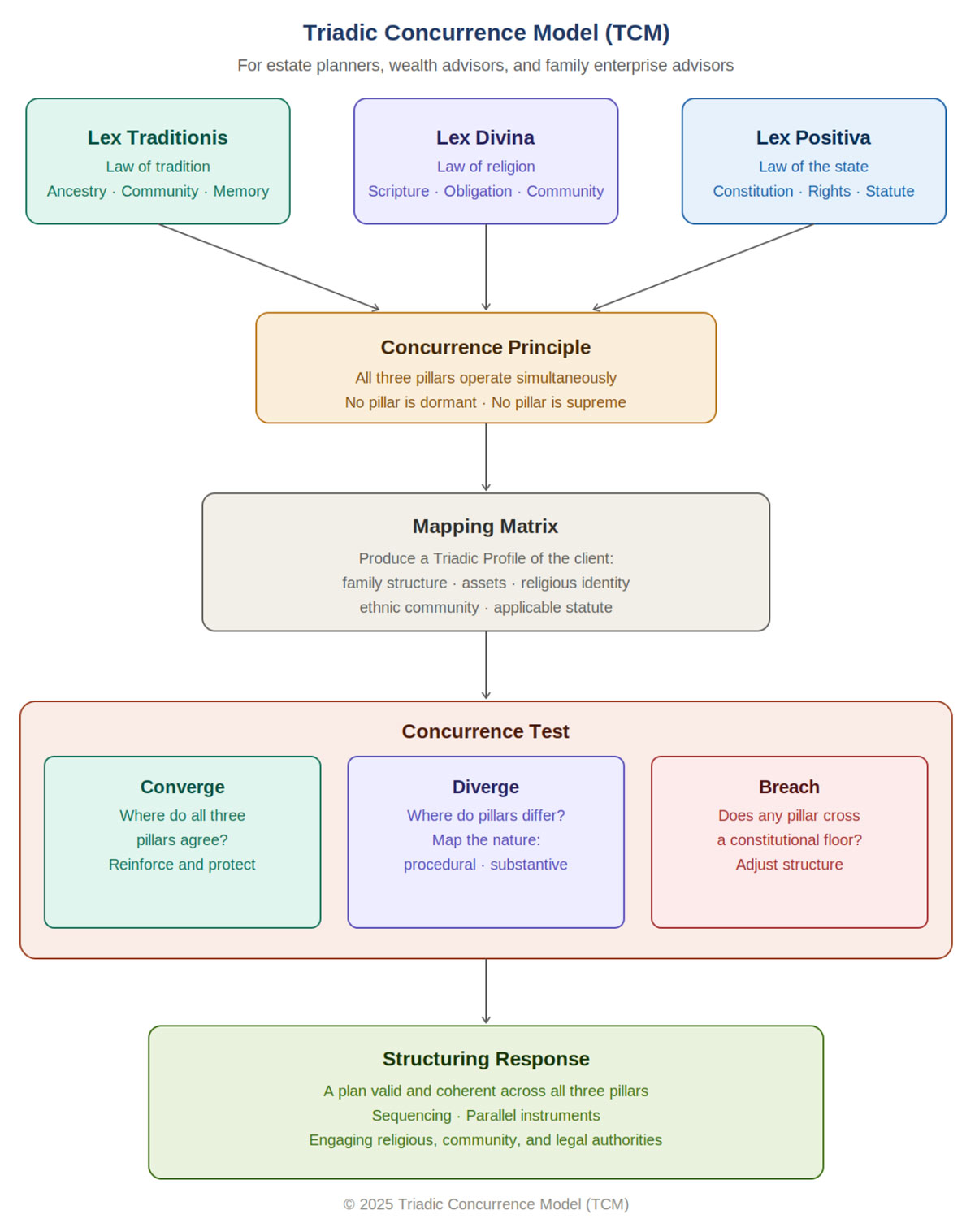
What emerges from this analysis is the need for a structured advisory framework that treats the three systems not as competitors for authority but as complementary sources of legitimacy, each grounded in a different dimension of the client’s identity and social world. The statutory system draws its authority from constitutional order and democratic enactment. The religious system draws its authority from divine obligation and sacred tradition. The customary system draws its authority from ancestry, communal memory, and inherited social norms.
None of these sources of authority disappears simply because the advisor chooses to focus on one of them. They operate simultaneously, making concurrent claims on the client’s situation. The advisor’s task is not to adjudicate between them but to understand what each is asserting, to identify where they converge and where they diverge, and to structure outcomes that each can recognize as legitimate on its own terms.
This analytical approach has direct practical implications for how the advisor structures a plan. Where all three systems converge on a particular outcome—recognizing the same heir, permitting the same transfer, endorsing the same family arrangement—that convergence is the plan’s most durable foundation. It should be identified, articulated, and protected. Where the systems diverge, the nature of that divergence matters: a procedural difference that can be resolved through sequencing is a very different challenge from a substantive conflict over who is entitled to inherit, which in turn is different from a values-based tension over gender equality that cannot be resolved through technical structuring alone.
Where any element of the proposed plan would breach the constitutional floor established by statutory law—embedding discriminatory provisions that courts would not uphold, or denying statutory entitlements without legal authority—the advisor must identify this clearly and ensure the client understands the consequences.
Tools of the Plural Environment
Within this framework, formal testamentary instruments remain important but are rarely sufficient on their own. The advisor in a plural legal environment must draw on a broader toolkit.
Inter vivos transfers, trust structures, and corporate holding arrangements may be used to remove assets from the formal succession framework in ways that achieve the client’s intended outcomes while reducing exposure to competing legal claims. Non-estate assets—insurance policies, pension benefits, jointly held property—provide additional structuring opportunities that operate outside the reach of customary or religious succession rules in many jurisdictions.
Where Islamic law applies, planning must account specifically for the constraints of the faraid system. The one-third rule on testamentary disposition is not an obstacle to be circumvented—it is a parameter within which the plan must be designed. Inter vivos transfers, waqf structures, and business succession arrangements may all provide routes to achieving the client’s objectives within the framework of religious obligation rather than in spite of it.
Perhaps most importantly, the advisor must engage with the actors—religious authorities, community elders, family councils—whose practical authority will shape implementation. In many plural legal environments, a plan that has not been acknowledged by these actors is a plan that may not survive the moment of succession, regardless of its formal legal validity. Their engagement is not a courtesy. It is a structural requirement.
Conclusion
Legal pluralism transforms wealth and succession planning from a technical legal exercise into a multidimensional process that spans law, culture, religion, and social dynamics. The central question for the family enterprise advisor is no longer simply how wealth should be structured, but how it can be structured in a way that anticipates and holds together the concurrent claims of three different legal and social systems.
This is a demanding standard. But it is the standard that the environment requires. Families who operate within plural legal realities deserve advice that meets them where they actually are—not advice that assumes away the complexity of the world they live in.
The jurisdictions of West Africa illustrate this complexity with particular vividness, but the challenge is not unique to them. Any advisor who works with families carrying multiple legal, cultural, or religious identities—whether in Africa, Asia, the Middle East, or among diaspora communities globally—will encounter the same fundamental condition: that more than one law governs this family, and that the plan must account for all of them.
References
Ukeje v. Ukeje (2014) 11 NWLR (Pt. 1418) 384—Supreme Court of Nigeria. The court held that the Igbo customary rule disinheriting female children was void as being in conflict with section 42(1) of the Constitution of the Federal Republic of Nigeria 1999.
DISCLAIMER: The views expressed in this article are those of the authors only. The information contained in this article is provided solely for informational purposes. This article does not constitute legal or tax advice or create an attorney-client relationship.
About the Contributors

Dennis Owusu Oteng, DBA, ACFBA, ACFWA, is a family enterprise advisor and wealth advisor whose practice focuses on multigenerational family businesses and succession planning.

Mercy Edukugho-Aminah, TEP, ACSI, CFWA, is a lawyer and registered Trust and Estate Practitioner (TEP) specializing in estate and wealth planning, with particular expertise in plural legal environments across West Africa.
View this edition in our enhanced digital edition format with supporting visual insight and information.