View this edition in our enhanced digital edition format with supporting visual insight and information.
In this week’s edition of FFI Practitioner, Jay Hughes, Mary Duke, and Stacy Allred offer the second in their 2026 series of Reflections on Family Flourishing, a companion to their upcoming new book. This reflection explores ghosts as a family-systems metaphor and offers practical ways to increase adaptive intelligence (AQ), draw constructively on ancestor wisdom, and protect against suboptimal outcomes – either a disconnect from ancestor wisdom or over-dependence on ancestor authority leading to fossilization.
Every family has ancestors. Some are named in stories, photographs, rituals, values, enterprises, or inherited practices. Others are barely remembered. When ancestors are acknowledged and honored, they can offer continuity, humility, identity, and wisdom. They are not ghosts simply because they have died.
By “ghosts,” we mean something different: an unintegrated influence from the past that still shapes the present indirectly.1 A ghost may arise from a denied or forgotten ancestor, an excluded living family member, an ungrieved loss, a family secret, an unresolved conflict, a trauma, or a moment when someone’s dignity was diminished. In this reflection, “ghost” is a metaphor for a felt pattern in the family system, not a universal spiritual claim. Not every ancestor is a ghost, and not every ghost is an ancestor. Ghosts are what the family has not yet found a truthful, respectful, and generative way to acknowledge.2
Families unfold like plays, with each generation representing a sequence of acts:
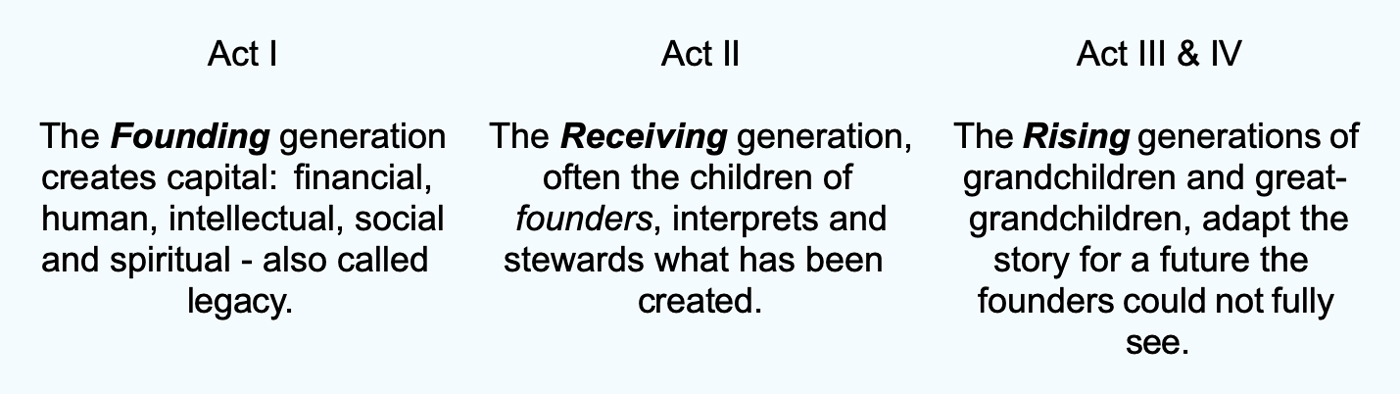
Each generation plays a distinct role in the larger play, strengthening the family through unity and conflict resilience3 or weakening it through unproductive conflict and neglect. The play metaphor helps families imagine their future. Will their story unfold as a comedy, with everyone still on stage and equipped to navigate the future, or as a tragedy, with key players lying in defeat or disappearing from the stage?
Like Shakespeare’s Hamlet, which is set in motion by the visitation of his father’s ghost calling on Hamlet to “Remember me,” families can be shaped by voices from the past. In more than 100 years of combined practice, we have yet to see a family without ghosts influencing its story. We have learned to begin by naming the players—past, present, and future—including the ghosts. It is often a mistake to assume only the living matter.

Ghosts Appear in Many Forms
Ghosts often represent unresolved issues that must find expression before the family can flourish. They may appear as silence around a loss, tension around an excluded person, repeated conflict no one understands, unexplained loyalty to an old rule, or the uneasy feeling that some story is missing from the family’s account of itself.
When families avoid naming or addressing these ghosts, they risk falling into a pattern of waiting and inertia—much like the characters in Samuel Beckett’s Waiting for Godot, who spend their days anticipating an event that never arrives. Inaction and avoidance can become their own haunting influence, leaving families stuck in cycles of uncertainty and missed opportunity. Moving from passive waiting to intentional engagement with the past can help families break free and move their stories forward.
Ghosts Can Carry the Pain of Lost Dignity
A family can create a haunting influence when a person is publicly diminished, excluded, or spoken about as though their gifts do not matter. In some cultures, this is described as the “taking of another’s face,” a wound so deep it creates a living ghost within the family system. Whatever the family names it—a loss of standing or a wound to dignity—the repair requires more than private regret. Public diminishment often needs a visible path back into recognition.
Consider a hypothetical example involving succession in a family foundation:4 At the anniversary dinner, a parent raises a glass: “Let’s be honest—Emma’s the only one responsible enough to lead the foundation.” The compliment lands like a cut. Emma looks uneasy, and her brother, Alex—who has been doing committee work for years—goes quiet. Alex feels publicly diminished.
Helping a family work to restore a member’s lost face is delicate yet profoundly healing work. Nursing the humiliation, Alex begins to disengage from the family. Emma finds the right time to pull her brother aside privately and says, “That comment put you in an unfair spot—I’m sorry.” They agree on a reset. While a generative repair might begin privately, it should not end there. At the next family foundation meeting, Emma recognizes Alex’s years of service and invites him to co-lead the next committee review. The family goes on to establish a more transparent leadership transition process. In this way, the family does not merely soothe hurt feelings; it restores standing, repairs trust, and creates a dignified path back into belonging. They prevent the wound from becoming a ghost in their system.
Ghosts Can Point to Unfinished Work
The journey of courageously exploring unresolved human emotions can open the way to healthier relationships. When an ancestor, a loss, or a story has been denied, ignored, dishonored, or forgotten, the family may experience that absence as a haunting influence. When the past is given a truthful and dignified place, the family can begin to draw on ancestor wisdom without being ruled by it.
Some cultural and spiritual traditions maintain formal practices of remembrance and intergenerational accountability. One example, offered with respect and attribution, is the Haudenosaunee emphasis on considering the effects of present decisions on the seventh generation to come.5 This offers families a reflection: What are our own respectful ways of remembering those who came before us and considering those who will come after us?
We encourage families to develop their own respectful practices for naming and remembering the departed at important gatherings. Naming keeps ancestors alive in memory, affirms their contribution to the family’s well-being, and integrates them into the ongoing story. When ancestors are remembered and acknowledged, they can bring vitality. They remind us that time is not only present and future, but also the past, woven into every act of the play.
Do the Work to Strengthen the System
Whoever seeks to be the playwright for a family must recognize both ancestors and ghosts. A strong family play taps into ancestor wisdom and also includes its ghosts, because only by acknowledging them can the family resolve what they represent and write the story it most desires.
When a family works through the unseen but felt dynamics and energies that come from past traumas and experiences, it strengthens the system. To flourish, families must give these ghosts their place on stage. From there, the play can unfold with honesty and hope. The past is always with us. The question is whether it will remain a haunting influence, operating through silence and repetition, or become part of a conscious, dignified, and generative family story.
Create Balance
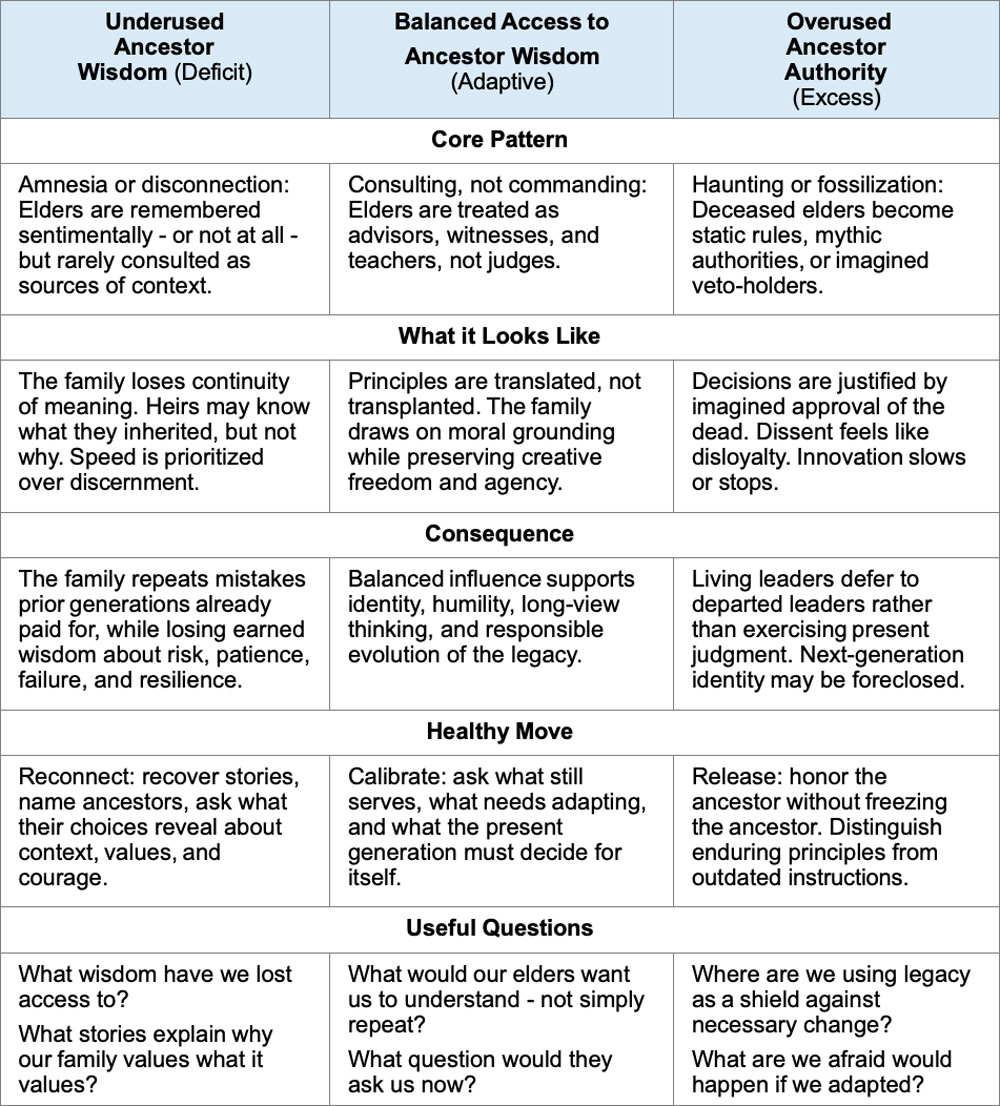
As with most things in life, balance is key. FYI: For Your Improvement—Competencies Development Guide6 uses a deceptively simple but powerful idea: every capability lives on a spectrum, and effectiveness depends on calibration, not maximization. A strength becomes a liability when it is underused or overused. The same is true for ancestor wisdom. Families can lose access to it through disconnection—or become trapped by it when reverence becomes rigidity.
Let’s apply this framework to explore how families can tap into the wisdom of deceased elders without becoming trapped.
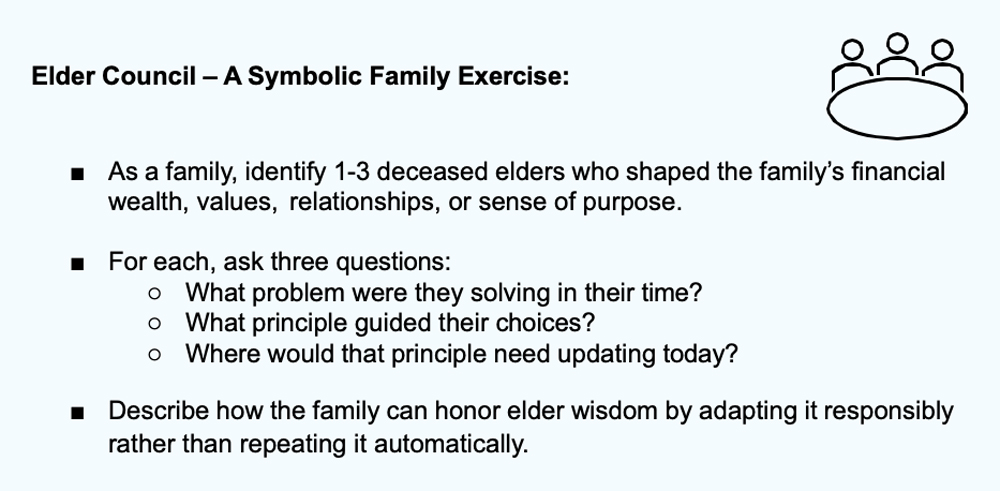
Key Questions for Families to Consider
- Who are the ghosts in our family story—named or unnamed, remembered or forgotten?
- Which ancestors are honored and integrated into the family story, and which ancestors or experiences have been denied, ignored, dishonored, or forgotten?
- What unresolved issues, losses, exclusions, or unspoken stories might be shaping our family’s present dynamics?
- Are there family members, past or present, whose dignity or contributions have not been fully honored?
- In what ways might avoidance or silence be holding our family back from growth or healing?
- Where might our loyalty to ancestral wisdom be limiting our ability to adapt wisely to important change?
- How can we create generative practices that name, honor, learn from, and responsibly integrate the wisdom of our elders and previous generations?
These questions invite families to look beyond the surface and consider the deeper influences shaping their shared journey. By courageously exploring the presence of “ghosts”—whether unresolved conflicts, forgotten ancestors, excluded members, or unspoken wounds—families can move from cycles of avoidance to cycles of healing and connection. In giving voice to the past, families not only honor those who came before but also empower themselves to write a more honest, resilient, and hopeful story for generations to come.
References
1 In this reflection, “ancestor” and “ghost” are used as family-systems metaphors, not as universal spiritual claims. Different cultures and faiths understand the dead, remembrance, and ongoing bonds in different ways, and this language should be used with humility and respect for those traditions.
2 James Hollis, Hauntings: Dispelling the Ghosts Who Run Our Lives (Asheville, NC: Chiron Publications, 2013).
3 Robert Bordone and Joel Salinas, Conflict Resilience: Negotiating Disagreement without Giving Up or Giving In(New York: Harper Business, 2025).
4 This case study is a fictional vignette created for illustrative purposes only. It does not depict or describe any actual person or family, and any resemblance to real individuals or circumstances is purely coincidental.
5 John Arthur Gibson, Concerning the League: The Iroquois League Tradition as Dictated in Onondaga (Syracuse, NY: Syracuse University Press, 1992).
6 Michael M. Lombardo and Robert W. Eichinger, FYI: For Your Improvement—Competencies Development Guide, 6th ed. (Minneapolis: Lominger International, 2014).
About the Contributors
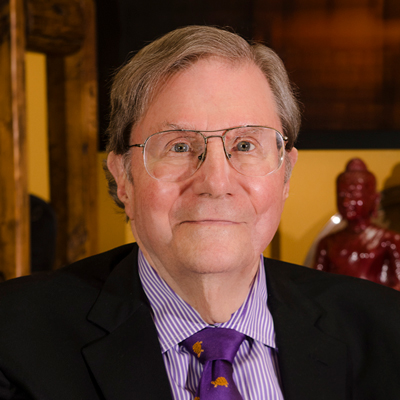
James “Jay” E. Hughes, Jr. has devoted his career to serving families seeking to discover and fulfill their purpose. Through his landmark work on the Five Capitals, Jay helped reshape the global conversation about wealth, advancing a broader understanding of holistic well-being across generations. He continues to advise families and family office leaders worldwide and serves as a guiding voice in the evolving field of family wealth.
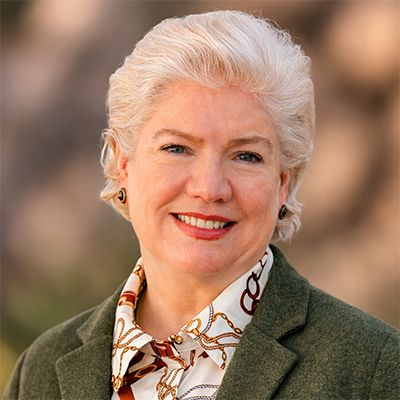
Mary Duke works with families to strengthen relationships, deepen trust, and accelerate meaningful results across the family system. With deep experience in fiduciary service and family enterprise leadership, she serves as trustee and director for select family enterprises and private trust companies. She also designs governance and learning systems that translate intention into lived experience. Her work with families around the world informs a global perspective and cultural sensitivity.
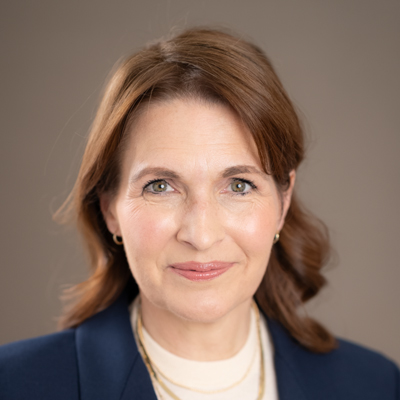
Stacy Allred serves as Managing Director and Head of Family Engagement and Governance at J.P. Morgan Wealth Management. Over the course of her career, she has helped multigenerational families build the skills, structures, and confidence needed to navigate wealth wisely. Stacy’s work sits at the intersection of practical governance and creating a learning family, grounded in the belief that enduring wealth depends on the ongoing and creative pursuit of moving towards potential. Her views are her own and do not necessarily reflect the views of JPMorganChase.
View this edition in our enhanced digital edition format with supporting visual insight and information.